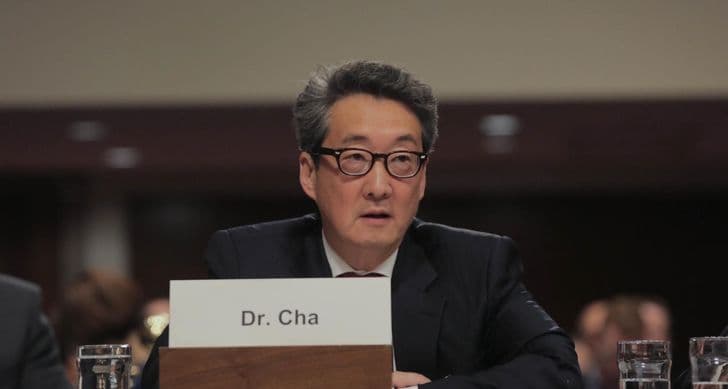
Victor Cha, who leads the geopolitics and foreign policy department at the Center for Strategic and International Studies, said he does not think President Trump has a problem acknowledging North Korea's possession of nuclear weapons, a reading that suggests Washington's approach to Pyongyang may be shifting away from denuclearization as the defining goal.
Cha framed Trump's comfort with the acknowledgment in political rather than strategic terms. In Trump's mind, Cha said, accepting that North Korea already has nuclear weapons is not his own failure but the failure of 35 years, an explanation that lets the president recognize reality on the ground without treating it as a defeat inflicted on his own watch.
A Number That Frames the Debate
The scale of that reality is not in dispute in Washington, even if outside estimates differ. Trump said last month that North Korea possesses 57 very powerful nuclear weapons, a figure that, whether precise or not, has effectively set the terms for how the administration talks about the North's arsenal going into any renewed negotiation.
A Summit Window Taking Shape
The timing adds urgency to the question. A potential meeting between Trump and Kim Jong-un could take shape sometime between November and the G20 summit in December, which is set to be held in Florida, giving Washington a compressed window to decide how it wants to frame the North's weapons before the two leaders are in the same room. Trump has met Kim three times before, in Singapore in June 2018, in Hanoi in February 2019, and at Panmunjom, giving both sides a working history to draw on even as the underlying goal of any talks appears to be shifting.
Pyongyang's Own Calculus
Cha suggested North Korea has reasons of its own to let the clock run before committing to a summit, noting that they are always looking to improve their position and may prefer to wait until after November's US midterm elections to negotiate from a stronger hand. Retired Gen. Vincent Brooks, who led US Forces Korea from 2016 to 2018, offered a blunter read on timing, saying the sooner it happens, the more performative it will be, a suggestion that a rushed summit risks becoming more about optics than substance.
Washington's Official Line Hasn't Caught Up
For now, the White House has stated that its North Korea policy remains unchanged, but officials have notably stopped short of reaffirming denuclearization as the goal, leaving a gap between the administration's public posture and the more accepting private read that experts like Cha are now offering. How that gap closes, or doesn't, may say more about the substance of any Trump-Kim meeting than the meeting's staging ever could.