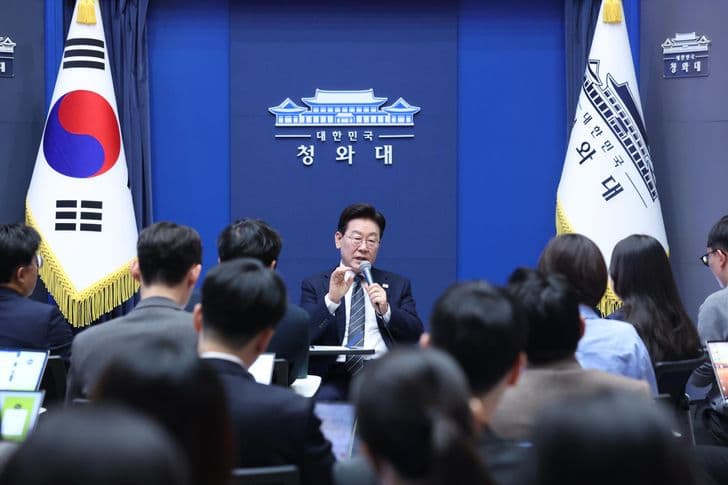
Marking 500 Days in Office, Lee Recommits to Taking Back Wartime Command by 2028
At a press gathering marking 500 days of his presidency, Lee Jae-myung restated his goal of reclaiming wartime operational control from the United States by 2028, arguing that a country with South Korea's economic and military weight should no longer depend on another nation to run its own war plans.
President Lee Jae-myung used a milestone moment, a press gathering marking his 500th day in office held Monday at Cheong Wa Dae, to recommit publicly to one of his longest-standing defense goals: taking back wartime operational control, or OPCON, of South Korea's armed forces from the United States by 2028.
Wartime OPCON, the authority to direct South Korean and American forces in the event of a war on the peninsula, has rested with a combined command led by the United States since the Korean War. Seoul has spent years working toward a transfer, and Lee's remarks were his clearest recent signal that he intends to hold the administration to that 2028 target.
A matter of sovereignty, in Lee's framing
The president cast the issue less as a military technicality and more as a basic marker of national sovereignty. He argued that a country of South Korea's standing, as a sovereign and independent state, needs to have operational control of its own forces simply to meet the baseline expectations of statehood, and said the country's economic weight, cultural reach and military capacity no longer justify leaving that control in another nation's hands.
Making the capability case
Lee leaned on specific figures to argue Seoul is ready for the handover. He pointed out that South Korea's annual defense spending alone equals roughly one and a half times the entire size of North Korea's economy, a gap he used to push back against assessments that count up ships and aircraft on each side. The more meaningful comparison, he argued, is in modern weapons capability, where he believes the South holds a clear edge regardless of how the numbers stack up on paper.
Downplaying friction with Washington
On the state of coordination with the United States, Lee struck a notably calm tone, describing any disagreements between the two allies over the handover as manageable rather than a serious rift. He characterized talks with Washington on the transfer as generally moving in the right direction, suggesting that the diplomatic groundwork, not just the military preparation, is advancing roughly on schedule.
A target date Lee is not backing away from
Pressed on timing, the president left little room for ambiguity, saying the country needs to reclaim OPCON at an early date and asserting that South Korea is fully capable of doing so. Coming on a symbolic 500-day marker rather than a routine briefing, the remarks read as a deliberate reaffirmation, a signal to both domestic audiences and Washington that the 2028 target remains the administration's fixed point rather than an aspiration open to drift.