
MoneyKOSPI

KOSPI Suffers Worst Single-Day Drop in Years as AI Spending Doubts Spread

South Korea's benchmark index tumbled 7.57 percent in a single session, erasing roughly 400 trillion won in market value, as a surge in U.S. bond yields reignited doubts about how long the AI-driven spending boom can keep justifying tech valuations.

By Korea First StaffPublished 2 min read
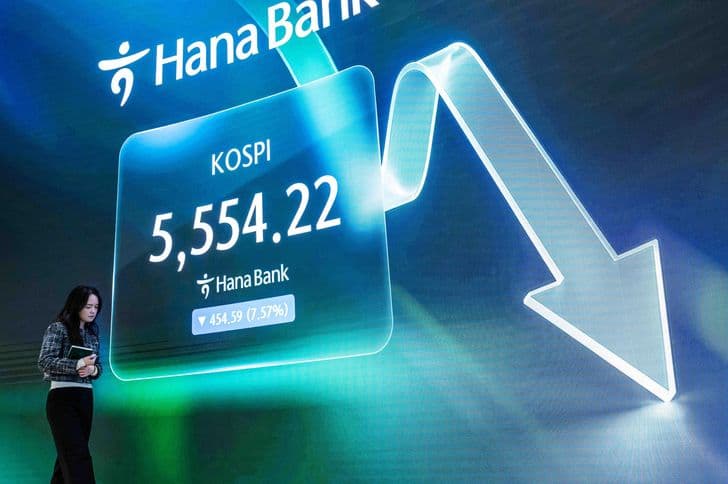
A screen at a bank branch shows the KOSPI index down 7.57 percent on a sharply falling day.
A screen at a bank branch shows the KOSPI index down 7.57 percent on a sharply falling day. · Source: Shim Hyun-chul

South Korean stocks suffered one of their sharpest single-day routs in recent memory, with the KOSPI sinking 7.57 percent to close at 5,554.22, a move that wiped out roughly 400 trillion won, or about 297.7 billion dollars, in market value in a single session.

The drop capped a brutal stretch rather than arriving out of nowhere. Over seven trading sessions since October 6, the index has shed close to 20 percent, erasing more than 1,100 trillion won in value and turning what had been a strong year for Korean equities into a sharp reversal.

A bond market jolt reignites AI spending doubts

The immediate trigger traced back to Washington rather than Seoul. Hotter-than-expected U.S. inflation data for September pushed the 10-year Treasury yield above 5.3 percent, raising the cost of the borrowing that has underwritten much of the global buildout of AI infrastructure. For investors already uneasy about how long that spending wave can keep justifying lofty valuations, the yield spike was enough to trigger a rush for the exits, particularly in Korea's chip-heavy market.

Chipmakers bear the brunt

Semiconductor giants absorbed the worst of the selling. Samsung Electronics dropped 9.48 percent to 210,000 won, while SK hynix fell 11.06 percent to 1.262 million won. Samsung Electro-Mechanics was hit even harder, sliding 15.36 percent, and the tech-heavy Kosdaq index fell 7.65 percent to close at 760.82, underscoring how concentrated the damage was in the very companies that had powered the market's earlier AI-fueled rally.

Circuit breakers kick in

The speed of the slide triggered Korea's automatic market safeguards. A sell-side sidecar, which temporarily halts program sell orders, activated at 9:07 a.m., the 27th such trigger this year, before a Level 1 circuit breaker froze trading briefly at 12:38 p.m. as the index continued its slide.

How this stacks up against past crashes

Lee Kyoung-min, an analyst at Daishin Securities, framed the scale of the damage in historical terms, noting the index is now down 40.4 percent from its June peak and is approaching the median decline of 43.7 percent recorded across seven previous market crises, a list of comparisons that has inevitably drawn parallels to episodes like Black Monday in 1987, the Asian financial crisis of 1997, the dot-com crash of 2000 and the 2008 global financial crisis.

Authorities call the drop excessive

Financial authorities convened an emergency meeting in response, describing the scale of the decline as excessive relative to the country's underlying economic position. Officials pointed to Korea's broader economic fundamentals and what they characterized as strong corporate earnings as reasons the selloff had overshot, even as they stopped short of announcing specific new intervention measures.

Tags

  • KOSPI
  • stock market
  • AI spending
  • Samsung Electronics
  • SK hynix
  • circuit breaker
Keep scrolling for more stories