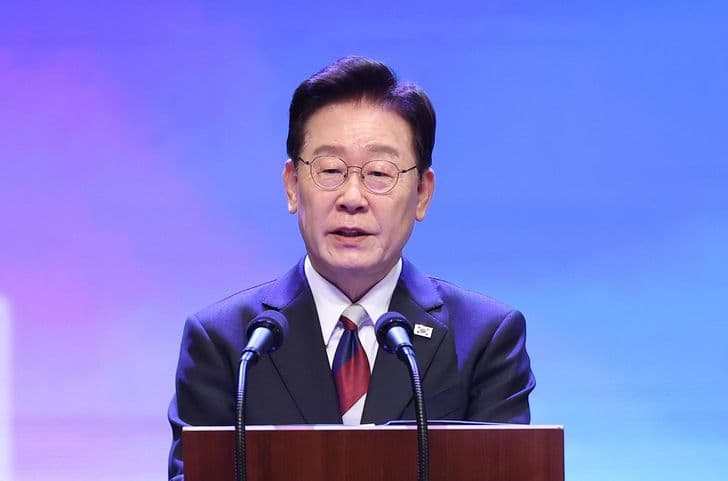
On Liberation Day, Lee Offers North Korea Talks to End the War and Freeze Its Nukes
In his Liberation Day address, President Lee Jae-myung proposed that the two Koreas sit down as the war's direct parties to replace the 1953 armistice with a lasting peace and to discuss halting the North's nuclear advance, an overture Pyongyang has so far met with silence.
President Lee Jae-myung used his first Liberation Day address to extend a hand to North Korea, proposing that the two sides open talks to formally end a war that has technically never stopped and to discuss curbing the North's nuclear program. He spoke on Friday at a ceremony in Seoul marking the 81st anniversary of Korea's liberation from Japanese rule.
The offer was direct. Let us put down our intentions to threaten each other, Lee said, and begin discussions to end the long-running war as the directly involved parties. In the same breath he opened the door to the harder subject, saying the two sides may also discuss effective ways to halt the advancement of the North's nuclear capabilities.
An armistice, not a peace
The proposal reaches back to an unfinished war. The fighting from 1950 to 1953 ended not with a peace treaty but with an armistice, leaving the two Koreas technically at war for more than seven decades. Lee framed his goal as replacing what he called the unstable armistice system with a permanent peace regime.
That language marks the ambition. An end-of-war declaration and a durable peace arrangement have been sought before and never secured, and Lee is proposing to pursue them as the parties most directly involved, a phrasing that stresses the two Koreas rather than the outside powers that also signed the truce.
Peace and the nuclear question, together
What sets the offer apart is how it ties peace to the nuclear issue. Rather than demand denuclearization as a precondition, Lee suggested addressing the North's weapons within a broader process of ending the war, raising the possibility of halting the program's advance as part of talks rather than before them.
He described the approach as steady rather than sudden. Lee spoke of reducing hostility across perceptions, norms and systems, of building a multilayered security framework, and of taking preemptive and consistent peace measures, the vocabulary of a long process built step by step rather than a single grand bargain.
A vision of coexistence
The president cast the effort in terms of living side by side rather than reunifying on anyone's terms. I hope South and North Korea will sit face-to-face for peaceful coexistence and mutual growth, he said, and pledged to turn the energy of hostility and confrontation into momentum for peaceful coexistence and mutual growth.
The framing is a deliberate lowering of the stakes. By speaking of coexistence rather than absorption, Lee is offering Pyongyang a future that does not require it to disappear, an argument aimed as much at reassuring the North as at persuading skeptics at home.
A hand extended into silence
The obstacle is that no one on the other side has answered. Since Lee took office in June 2025, North Korea has stayed unresponsive to Seoul's reconciliatory gestures, and there is little sign that a holiday speech will change that.
For now the proposal is a statement of intent more than a negotiation. Lee has set out a direction, peace before denuclearization, coexistence over confrontation, and the parties as the two Koreas themselves. Whether it becomes anything more depends on a government in Pyongyang that, for the moment, is not picking up the phone.