LG and Nvidia Team Up on a Humanoid Robot Due Early Next Year
LG will unveil a bipedal humanoid robot in early 2027 built on Nvidia's AI platform, part of a broad partnership that also spans data centers and self-driving cars, pairing Korean hardware with American intelligence.
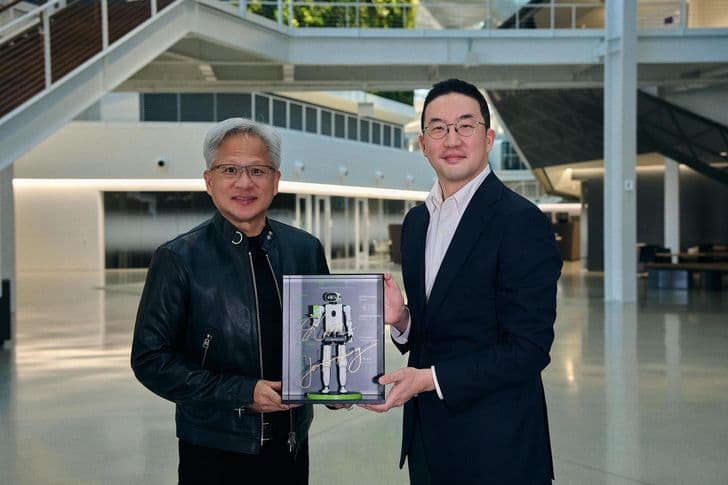
LG plans to unveil a humanoid robot early next year built on Nvidia's artificial intelligence platform, the product of a deepening partnership between the Korean conglomerate and the world's dominant maker of AI chips. The two companies signed an agreement to that effect on Thursday at Nvidia's headquarters in Santa Clara, California.
The deal formalizes a collaboration that has been building for months. LG Group Chairman Koo Kwang-mo first met Nvidia chief executive Jensen Huang in Seoul on June 5, and the two returned to the table in California to set out a broad plan spanning robots, data centers and self-driving cars.
A robot with Korean muscle and American brains
The centerpiece is a bipedal humanoid robot due to be revealed in the first quarter of 2027. Its design splits the work between the partners, with Nvidia supplying the intelligence and LG the body.
On the Nvidia side, the robot will run on the Jetson Thor onboard computer, draw on the Isaac GR00T foundation model as its development platform, and use a system called Halos for Robotics to keep it operating safely around people. LG supplies the physical parts, its own actuators serving as the muscles, LG Innotek sensors as the eyes, and LG Energy Solution batteries for power.
More than one machine
The robot is only the most eye-catching piece of a wider pact. In physical AI, LG is already testing a wheel-based robot called CLOiD on a washing machine production line in Tennessee, and it is developing its own robot foundation model to reduce its dependence on outside software.
The partnership reaches into infrastructure as well. LG plans a reference data center built on Nvidia's Vera Rubin platform in the first half of 2027, followed by an 80-megawatt facility in Cheonan, in South Chungcheong Province, in the first half of 2028. In cars, the two will work to integrate Nvidia's DRIVE Hyperion autonomous driving platform.
What the two sides are betting on
Both leaders framed the deal as a wager on physical AI, the idea of machines that can perceive and act in the real world rather than only process information on a screen. Chairman Koo said that as the collaboration gained momentum, the tasks where the two companies can work together had become clearer across AI factories, physical AI and mobility.
Huang put the ambition in sweeping terms. The defining opportunity of physical AI, he said, is to give every machine the ability to understand the real world, reason and act safely alongside people. For Nvidia, a humanoid running its stack is a showcase; for LG, it is a bid to matter in a field that could reshape both factories and homes.
From appliances to androids
The move fits LG's push to grow beyond the appliances and electronics that made its name. By pairing its manufacturing depth with Nvidia's software, the company is trying to convert decades of building machines that wash and cool into the harder task of building machines that walk and reason.
The real test comes when the robot is shown. A humanoid is easy to promise and hard to deliver, and the gap between a polished unveiling and a machine that works reliably in the world is where many robotics ambitions have stalled. Early next year, LG will have to show which side of that line its creation falls on.