Lee Floats a Steep Rise in Property Holding Taxes to Cool Housing Speculation
At a marathon housing forum in Seoul, President Lee Jae-myung argued that Korea's holding taxes would need to climb several times over to match advanced economies, while pledging to spare owner-occupiers and target those who hoard homes.
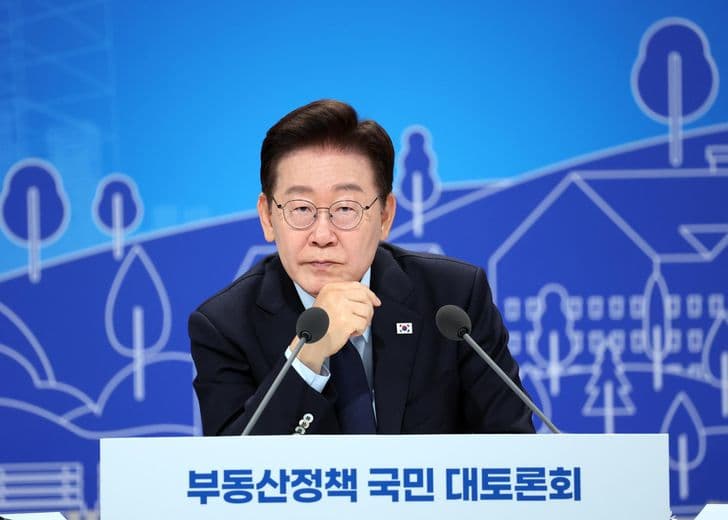
President Lee Jae-myung used a lengthy public forum on housing in Seoul on Thursday to make his clearest case yet for heavier taxes on property owners, signaling that the government is preparing to lean on the tax code to take the heat out of a market that keeps outrunning policy. Speaking at KBS Hall in Yeouido before a room of roughly 140 experts, agents, academics and members of the public, he framed the country's low holding taxes as a structural weakness that can no longer be ignored.
The session was scheduled to run 100 minutes and stretched past three hours, a sign of how central the housing question has become to Lee's early agenda. His central message was blunt. Left untouched, he warned, the imbalance in the property market would eventually deliver a heavy blow to the wider economy.
Bringing holding taxes in line with peers
The most striking figure Lee put on the table concerned the gap between Korea and other wealthy nations. To bring the country's holding taxes up to the level seen across advanced economies, he suggested, they would need to rise by at least three times. That is a far larger move than anything currently on the books, and it sets an ambitious marker for the tax package the administration is expected to unveil later this month.
Lee was careful to note the practical hurdles. Setting the right rate is difficult, he conceded, as is drawing the line for what counts as a high-value home that should carry a heavier burden. Those thresholds are where past attempts at property tax reform have tended to founder, and the president acknowledged that the details will decide whether the policy works or backfires.
Owner-occupiers versus multiple-home owners
Rather than a blanket increase, Lee sketched out a two-track approach. Households living in the single home they own would be treated differently from investors who accumulate multiple properties as a bet on rising prices. The intent is to protect ordinary residents while making speculation more expensive, a distinction that has long been popular in principle but tricky to enforce in practice.
The pitch reflects a political calculation as much as an economic one. Broad tax hikes on homeowners tend to provoke backlash, so the administration is betting that a design aimed squarely at those holding several homes will hold public support while still cooling demand at the speculative end of the market.
Cheap loans in the crosshairs
Lee also pointed to the lending system as a driver of runaway apartment prices, singling out the jeonse deposit loan programs that underpin Korea's distinctive rental model. The government, he argued, had allowed these loans to become effectively unlimited under the banner of helping low-income tenants, and that flood of cheap credit had ended up feeding price gains rather than easing them.
His proposed remedy is to tighten access to those loans while steering support toward the groups he says need it most, including young people, newlyweds and first-time buyers. The shift would narrow a program that has grown into one of the largest channels of housing finance in the country.
Building more, carefully
On the supply side, Lee reaffirmed plans for a third generation of new towns, with roughly 170,000 homes envisioned in areas ringing the capital, among them Namyangju, Hanam and Goyang in Gyeonggi Province. Fresh supply on that scale is meant to relieve the pressure that has pushed prices higher, particularly in and around Seoul.
He struck a more cautious note on redevelopment, warning that tearing down and rebuilding existing neighborhoods often ends up reducing the total number of households a site can hold. That skepticism suggests the government will favor new construction on open land over the redevelopment projects that developers and some homeowners tend to prefer.
What comes next
The comprehensive real estate tax package expected later in July is where these ideas will meet reality. It is set to cover both holding taxes and capital gains, the two levers that most directly shape the incentive to buy, hold and sell property. How aggressively the final plan moves, and where it draws its thresholds, will determine whether Thursday's forum marked a genuine turn in housing policy or another round of intentions that stall before they reach households.