
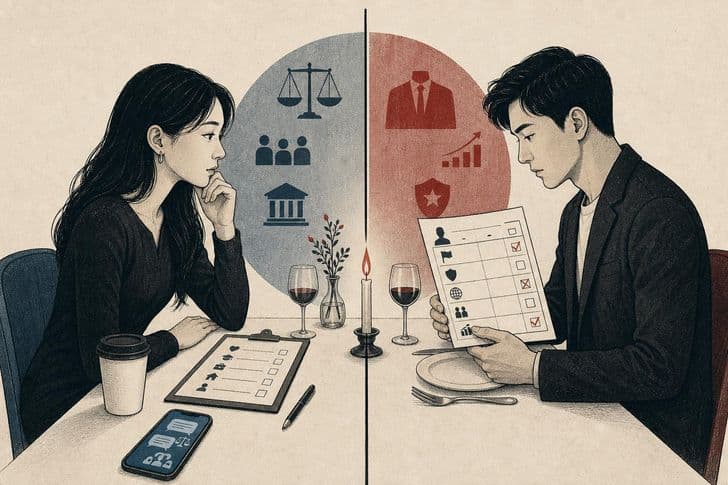
A roundtable of six young Korean adults, run as part of the Hankook Ilbo discussion series Tiki-Taka, describes a dating culture in which checking a potential partner's values has become as routine as checking whether the conversation flows, with participants screening dates on politics and gender attitudes before deciding whether to invest further.
The vetting starts online. Participants said they look at a potential partner's social media accounts and the online communities they participate in, treating which political candidates someone follows as a signal of active, rather than passive, political support. From there, the screening moves into direct conversation, with participants asking pointed questions about gender equality and attitudes toward sexual minorities to gauge where a partner actually stands.
Small Answers, Big Verdicts
The stakes attached to these checks are not small. Several participants described a partner's understanding, or lack of it, of the gender pay gap as a genuine test of relationship compatibility, and how someone reacts to a story about workplace sexual harassment was described as revealing something closer to a person's fundamental values than their taste in movies or food ever could. One participant said a relationship grew distant after her boyfriend failed to grasp the seriousness of penalties for workplace sexual harassment against women, a gap in understanding that reshaped how she saw the relationship going forward.