KT and Palantir Run an Internal Hackathon to Put AI Agents Into the Telco's Core Operations
At a three-day event called Agent Camp, KT staff built AI agents on Palantir's platforms aimed at the company's main business lines, a sign of how South Korean telecoms are trying to move AI from pilots into daily operations.
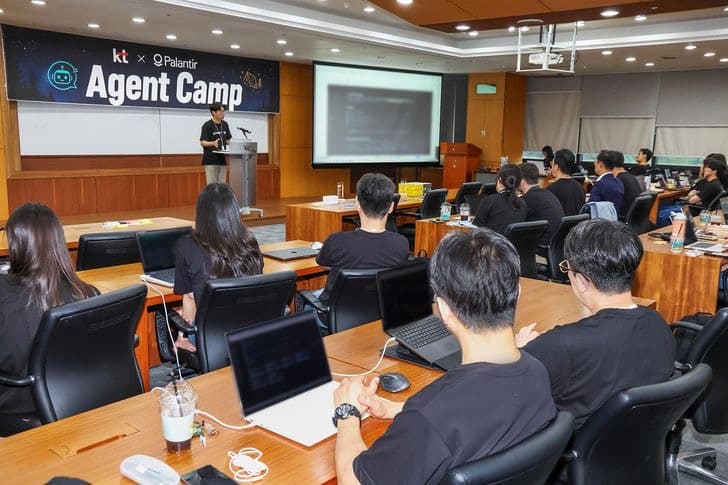
KT held a three-day internal hackathon with Palantir this week, gathering employees at its office in Seongnam, Gyeonggi Province, to build AI agents for use across the telecom's core operations.
The event, branded Agent Camp, had staff develop the agents on Palantir's platforms rather than from scratch, and pointed them at KT's main business lines rather than at abstract demonstrations.
Why a hackathon, and why Palantir
An internal hackathon is a way for a large company to find out what its own people can build when handed a new toolset and a short deadline. The output is rarely a finished product. The point is to surface which parts of the business an AI agent could actually help with, and to do that with the employees who understand those parts rather than an outside vendor guessing.
Palantir's role is the platform underneath. Its software is built to connect a company's scattered data and let teams assemble applications, including agents, on top of it. For a telecom that sits on large volumes of network and customer data, the appeal is a route to working software without building the plumbing first.
The wider push
The event fits a pattern among South Korean carriers, which have spent the past few years describing themselves as AI companies as much as network operators. The harder step is the one Agent Camp is aimed at: moving from announcements and pilots to systems that handle real work inside the business.
Whether agents built in three days become anything KT runs day to day is the open question. Hackathons are good at producing prototypes and less reliable at producing the follow through that turns a prototype into an operational tool, which is the distance any of this still has to cover.