China's Top Diplomat Pitches Beijing as a Steady Hand on the Korean Peninsula
On his first trip to Seoul since 2021, Chinese Foreign Minister Wang Yi pledged a constructive role in peninsula peace and pressed Washington to drop what he called a long-standing hostile policy toward North Korea, as separate signals point to a possible Trump-Kim meeting in November.
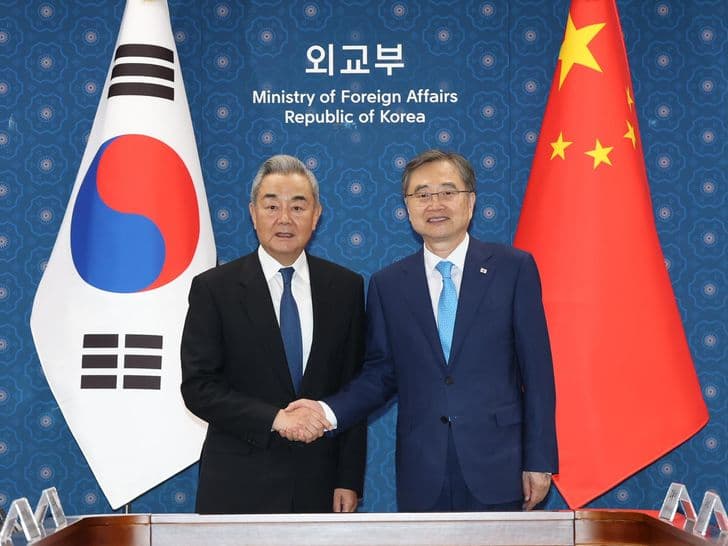
South Korean Foreign Minister Cho Hyun and Chinese Foreign Minister Wang Yi shake hands in front of the South Korean and Chinese flags. · Source: Joint Press Corps
Chinese Foreign Minister Wang Yi made his first visit to Seoul since September 2021, using the trip to position Beijing as a stabilizing partner just as diplomacy around the Korean peninsula picks up pace on several fronts at once.
Meeting with South Korean Foreign Minister Cho Hyun, Wang said China would keep playing a constructive role for peace, development and stability on the peninsula, an offer that arrived as Seoul weighs how much room Beijing should have in talks that have historically run through Washington. Cho responded that Seoul expects cooperation with China grounded in peace and stability, a carefully worded answer that welcomed the gesture without committing to specifics.
A Pointed Message for Washington
Wang did not limit himself to pleasantries. He said the United States must change its long-standing hostile policy toward North Korea, a direct jab that puts Beijing's diplomatic weight behind the argument that Washington, not Pyongyang, holds the key to unlocking talks. The line reflects China's longstanding position that North Korea's nuclear program is, at its root, a response to a security threat it perceives from the US rather than a threat Beijing itself needs to manage alone.
A Widening Cast of Players
The visit landed in the middle of a busy diplomatic stretch. President Lee Jae-myung used his National Liberation Day address on Saturday to lay out a blueprint for peace built around talks among the parties most directly involved, South Korea, North Korea, the United States and China, a formula that would formally include Beijing in a process it has often watched from the sidelines. Lee's plan also envisions multiparty talks aimed at a formal end to the 1950-53 Korean War, which stopped with an armistice rather than a peace treaty.
Separately, word has circulated of a possible meeting between President Trump and North Korean leader Kim Jong-un in November, on the sidelines of the APEC summit in Shenzhen, China. If it happens, the meeting would put Trump on Chinese soil for a summit with Kim, adding another layer to Beijing's claim on a mediating role. The backdrop to all of this is a joint South Korea-US military exercise that was scaled back on Wednesday, a decision that has already stirred debate in Seoul over what it signals for the alliance's posture toward the North.
Cautious Optimism in Seoul
Beijing's overture comes as Seoul-China relations recover from a stretch of tension, and Wang's trip is widely read as an attempt to bank that improvement before the peninsula's diplomatic calendar gets more crowded. Whether Beijing's newly stated constructive role turns into real leverage will likely hinge on what happens next, starting with whether a Trump-Kim meeting in Shenzhen actually comes together.