
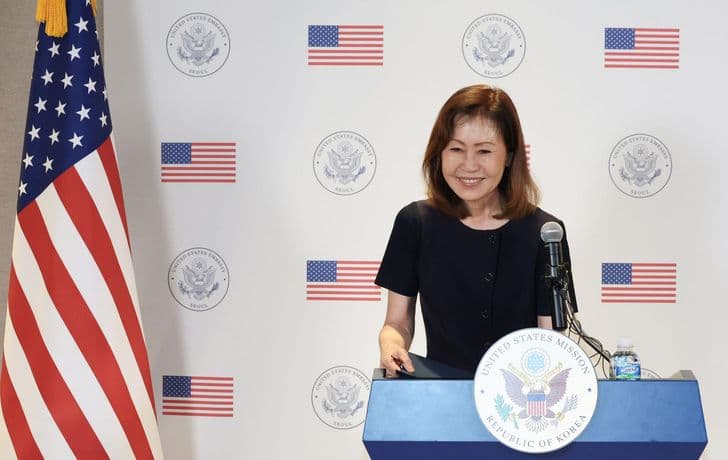
The United States has a new ambassador in Seoul, and she arrived with warm words for an alliance she called one of the strongest in the world. Michelle Steel touched down at Incheon International Airport on Thursday, filling a post that had stood empty for roughly a year and a half.
Steel carries an unusual biography for the role. Born in Seoul and Korean American, she described herself as a figure shaped by both countries, and she becomes only the second Korean American to serve as Washington's envoy to Korea, after Sung Kim held the job from 2011 to 2014.
An alliance measured in decades
Her opening message leaned heavily on continuity and reassurance. The United States and the Republic of Korea, she said, have stood together for more than 140 years, and today the partnership stands as one of the world's strongest alliances.
She framed the relationship in the language of security, saying she looked forward to working with Korea to ensure that the ironclad alliance remains a linchpin of peace and stability in the region. It was a message aimed at a Korean audience attentive to any sign of American commitment.
Carrying a president's vision
Steel left no doubt about whose agenda she intends to advance. Together, she said, the two countries would carry President Trump's vision for the alliance forward, stronger, safer and more prosperous than ever before. The framing tied her mission directly to the White House she serves.
The alliance she inherits is already the subject of high-level contact. President Lee Jae-myung met Trump in October at the APEC gathering in Gyeongju, and the ambassador arrives as the two governments work through the familiar file of security, trade and burden-sharing questions that define the relationship.
A vacancy finally filled
Steel's arrival closes an unusually long gap. Her predecessor, Philip Goldberg, departed around January 2025, leaving the ambassadorship vacant for about eighteen months, a stretch during which the embassy was run without a Senate-confirmed chief at a time of active diplomacy.
Her personal ties to American conservative politics are close. Her husband, Shawn Steel, is a Republican figure with connections to Trump, a background that shapes how both supporters and opponents in Seoul read her appointment.
A divided welcome
The reception in Korea has been mixed. Supporters see her Korean roots and Washington relationships as an asset, someone well placed to bridge the two capitals and translate between them at a delicate moment.
Critics, particularly progressive lawmakers and civic groups, have opposed the appointment, pointing to her past criticism of engagement with North Korea and describing her as far to the right. How she manages that skepticism, while pressing an agenda set in Washington, will shape the early months of her tenure.