
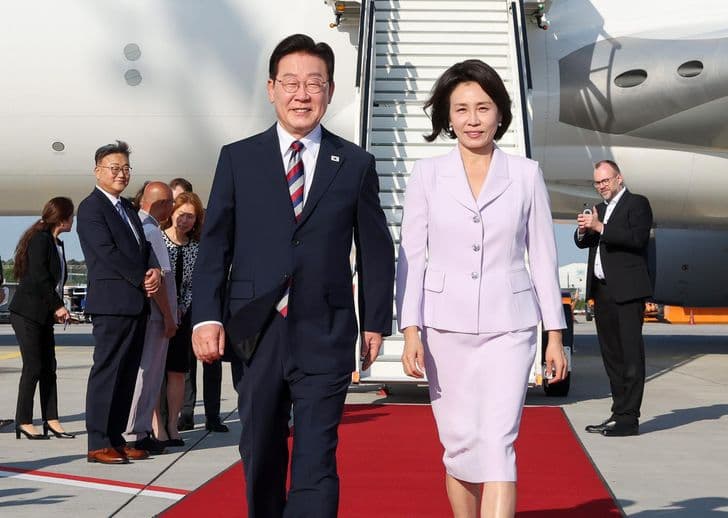
President Lee Jae-myung landed back in Seoul on Monday after an eleven-day trip abroad, returning with a stack of economic and security agreements and a domestic agenda that will test whether any of them translate into relief at home.
The journey, which began on July 24, carried Lee through Germany, the United States, Brazil, Chile and Argentina, a route that mixed a marquee technology summit with a resource-hunting swing through South America. The gains were real, but so is the list of problems waiting for him.
What he brought back
The centerpiece was artificial intelligence. In San Francisco, Lee unveiled a declaration on AI and met the executives who run Nvidia, OpenAI, Anthropic and Broadcom, while Korean and American companies lined up projects valued at a combined 950 billion dollars. Korea, Lee said, would become an indispensable player in the global AI supply.
The South American leg was about raw materials. Brazil produced a cooperation agreement on rare earth elements, Chile brought pledges on lithium and copper, and Argentina yielded a memorandum of understanding on critical minerals, a double taxation avoidance agreement and a plan for crude oil imports to begin next year. Together they read as an effort to secure the inputs Korean industry cannot do without.
The tests at home
The homecoming is where the harder work begins. Lee has called a cabinet meeting for Tuesday to discuss follow-up measures, with policy briefings lined up from the foreign, unification and defense ministries as the government tries to convert announcements into action.
One decision cannot wait. Lee faces a fifteen-day window to act on a review of the Criminal Procedure Act, a domestic legal matter that will draw attention regardless of what he decides. It is the kind of issue that can quickly overshadow a week of summitry.
An economy that has to be felt
The broader challenge is the economy itself. Domestic demand has been slowing, and the deals struck abroad, however large, will take years to show up in ordinary lives. In the National Assembly, an opposition ready to resist gives the government little room to move.
Political commentator Kim Sang-il put the problem bluntly, saying that ultimately the real issue is Korea's economy, and that diplomatic achievements matter only if people feel the benefits. It is a standard the trip's headline numbers cannot meet on their own.
The gap to close
For a president, a successful foreign tour offers a burst of momentum, a run of images and figures that suggest command of events. The question is how long that lasts once the plane has landed.
Lee returns with the stronger hand abroad that the trip was designed to produce. Whether it steadies him at home depends on the slower, less photogenic work of the weeks ahead, on budgets, bills and an economy that has yet to feel the benefit of the deals now signed.