
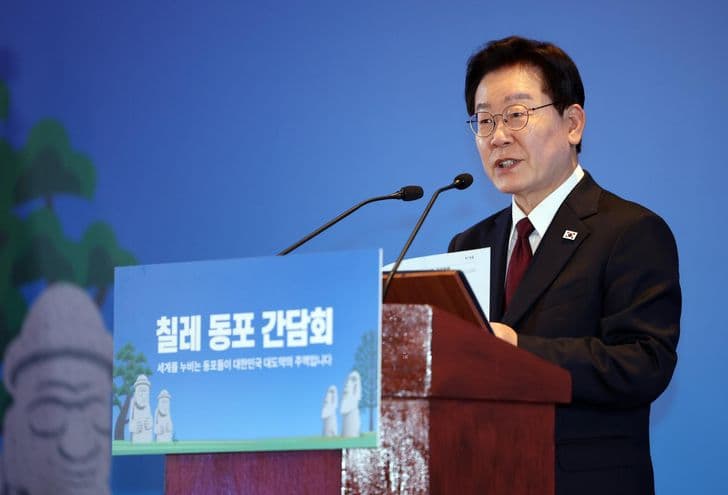
President Lee Jae-myung used a stop in Santiago to remind his audience how far back the ties between Korea and Chile run, casting the South American nation as an early and unusually loyal friend. It was the first visit by a Korean president to Chile in eleven years, and Lee leaned on history to give it weight.
Speaking to members of the Korean community, he traced the relationship to a moment when Korea had little standing in the world. Chile, he noted, recognized the Republic of Korea in 1949, the year after the Korean government was established, and later became the country's first free trade partner.
A friendship dated to 1949
Lee framed that early recognition as more than a diplomatic formality. Chile, he said, was a country that recognized Korea's potential and extended a helping hand at a time when the world knew little about it, a gesture he presented as the foundation of a lasting bond.
He summed up the relationship in a single line, saying it had always been built more on trust than distance. For two countries separated by an ocean and a hemisphere, the phrase was meant to close the gap that geography opens.
The trade deal that started a run
The centerpiece of Lee's message was the Korea-Chile free trade agreement, which took effect in April 2004. It was Korea's first such deal, and it opened a path the country would follow aggressively in the years after, striking agreements with the United States, whose pact entered force in March 2012, and China, whose deal followed in December 2015.
Placing Chile at the start of that sequence served a purpose. It let Lee present the South American nation not as a minor partner but as the country that helped Korea learn to trade the way it does now, through a widening web of agreements.
A tour aimed at Mercosur
The Santiago stop is one leg of a three-nation swing through South America, and the strategy behind it is trade. Lee is pressing to expand Korea's commerce with the region and with Mercosur, the bloc that anchors much of South American trade.
His pitch rests on complementarity. Korea brings advanced manufacturing, digital technology, shipbuilding and batteries, while the region offers agriculture, energy and the critical minerals that the clean-energy and chip industries increasingly depend on. Each side, in this framing, has what the other needs.
History as diplomacy
The gathering itself, a dinner with Korean residents held on Wednesday local time, underlined how much of the visit was about narrative as well as commerce. Speaking to the diaspora let Lee tell a story of loyalty repaid and roots maintained far from home.
The article named no new trade figures or agreements, and the visit produced no headline deal. What it produced was positioning, a reminder that Korea's global trade network began with Chile, and a bid to turn that shared history into a firmer economic footing across Latin America.