
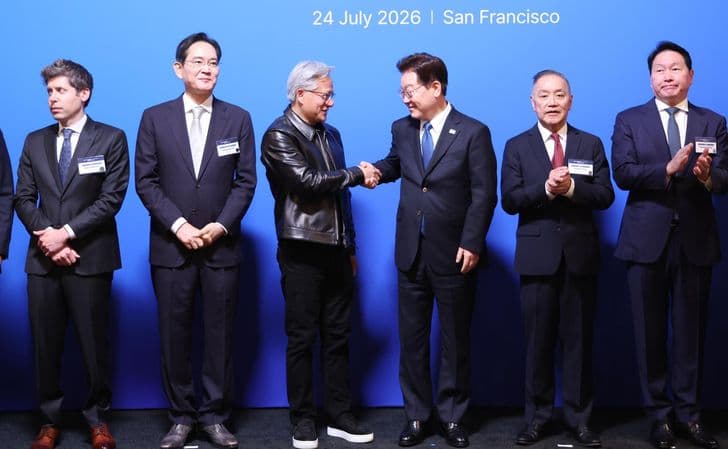
The 950 billion dollars in partnerships that Korean and global technology companies announced in San Francisco are being read less as a one-off spending spree than as a structural shift, one that fastens Korea's chipmakers to the core of the world's artificial intelligence economy.
The deals span Samsung Electronics, SK Group, Hyundai Motor Group and Naver on the Korean side, matched with Nvidia, OpenAI, Broadcom and Anthropic. Taken together, they turn a week of summitry into a set of long-term commitments that are hard to unwind, and that place Korean hardware at the base of nearly every layer above it.
The chip deals, broken down
The largest commitments run through memory. SK Group signed long-term agreements worth some 750 billion dollars over five years, including a partnership between SK hynix and Nvidia valued at more than 500 billion dollars and centered on high-bandwidth memory, the specialized HBM chips that AI accelerators cannot function without.
Samsung Electronics added a strategic partnership with Broadcom worth 200 billion dollars through 2030, reaching across memory, foundry manufacturing and advanced packaging. Naver committed about 10 billion dollars to what it calls AI factories, gigawatt-scale computing sites planned worldwide with Nvidia and the Canadian asset manager Brookfield.
Where the metal actually lands
Some of the agreements are concrete enough to name the hardware. SK Telecom is to build a two-gigawatt data center running on Nvidia's Vera Rubin processors paired with SK hynix HBM4 memory, a pairing that reads like a blueprint for how Korean components and American compute are meant to fit together.
That specificity matters. Framework deals often stay abstract, but naming the chips and the capacity turns a memorandum into something closer to an engineering plan, and signals that the buyers intend to build rather than merely to announce.
A declaration of intent
President Lee Jae-myung used the moment to unveil what he called the San Francisco Declaration on AI, casting Korea as an irreplaceable pillar of the global AI supply. Building on the country's world-class strength in memory, he said, Korea would serve as a trusted manufacturing base and a global test bed and production platform for the technology.
The language was deliberate. Rather than pitch Korea as a buyer of AI or a rival lab, Lee positioned it as the indispensable supplier, the place the rest of the industry has to route through, and framed the goal as sharing the benefits of AI across nations rather than hoarding them.
Why the supply chain runs through Seoul
The underlying logic is simple. The models and data centers absorbing the world's attention depend on a narrow set of components, and Korean firms make much of the most critical layer, the high-bandwidth memory that keeps advanced processors fed. Locking in supply for years gives global buyers certainty and gives Korea leverage.
The declaration also gestured at a wider ambition, using cooperative frameworks to narrow the gap between the nations that lead in AI and those that lag. Whether the 950 billion dollars translates cleanly into built capacity will take years to judge, but the direction is clear enough, that the road to the AI future is being paved, in large part, with Korean chips.