
The share of foreign residents in South Korea has climbed above 4 percent for the first time, a milestone that says as much about the country's shrinking native population as it does about immigration. As of November 2025, 2.11 million foreign nationals were living in Korea, or 4.1 percent of the total.
The rise was not marginal. Foreign residents grew by 66,000 over the year, up 3.2 percent, even as the number of Korean nationals fell by 54,000. The result, according to the Ministry of Data and Statistics, was that the country's overall population edged up by just 12,000, a gain of 0.02 percent, held aloft entirely by newcomers.
A steady climb
The 4 percent line was crossed gradually rather than in a single jump. The foreign share stood at 3.2 percent in 2021 and rose every year that followed, to 3.4, then 3.7, then 3.9, and now 4.1 percent. The trajectory points in one direction, and there is little in the underlying demographics to reverse it.
Kyoung Eun-suk, who directs the population census division at the ministry, put the dynamic plainly, saying the increase in the overall population was driven by growth in the foreign population despite a decline in Korean nationals. In other words, without immigration the country would already be shrinking.
An aging, thinning workforce
The pressure behind those numbers is the graying of Korean society. People aged 65 and older now make up 20.7 percent of the population, up from 19.5 percent a year earlier. At the other end, the working-age population, those between 15 and 64, fell by 393,000 to 35.87 million.
That leaves the working-age group at 69.2 percent of the population, the first time it has dropped below 70 percent. Each year the country has fewer people of prime working age to support more retirees, and the arithmetic is what draws migrant labor in.
Younger, and ready to work
Foreign residents help precisely where Koreans are thinnest. Some 89.3 percent of them are of working age, against 68.4 percent of Korean nationals, and their median age is just 36.1 years. The largest cohort is in their thirties, followed by their twenties.
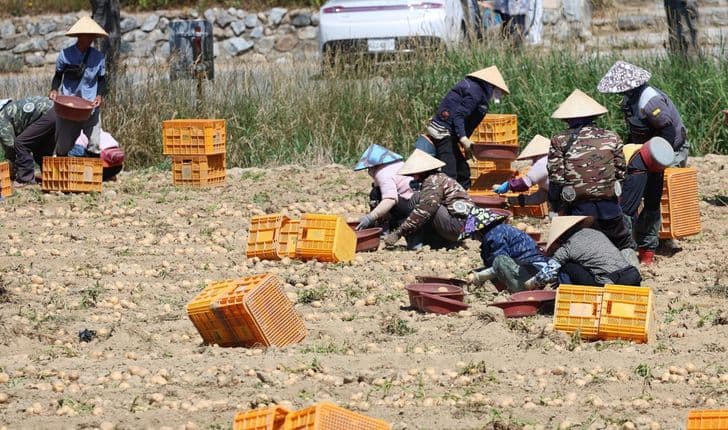
Much of that labor flows into farming and fishing, where shortages are most acute, channeled through government employment permit and seasonal worker programs. The people bent over the fields at harvest are increasingly likely to have arrived from abroad.
A changing map of origins
Where the newcomers come from is shifting too. Ethnic Koreans holding Chinese nationality remain the largest group at 25.3 percent, followed by Vietnamese at 15.1 percent, ethnic Chinese nationals at 10.5 percent and Thai at 7.5 percent.
The momentum, though, belongs to Southeast and South Asia. Over the decade to 2025 the Vietnamese population grew by more than 150 percent, while the numbers of Thai and Nepali residents more than doubled. American and Taiwanese residents, by contrast, declined. A country long defined by its homogeneity is being reshaped, quietly and steadily, by who is choosing to come.