
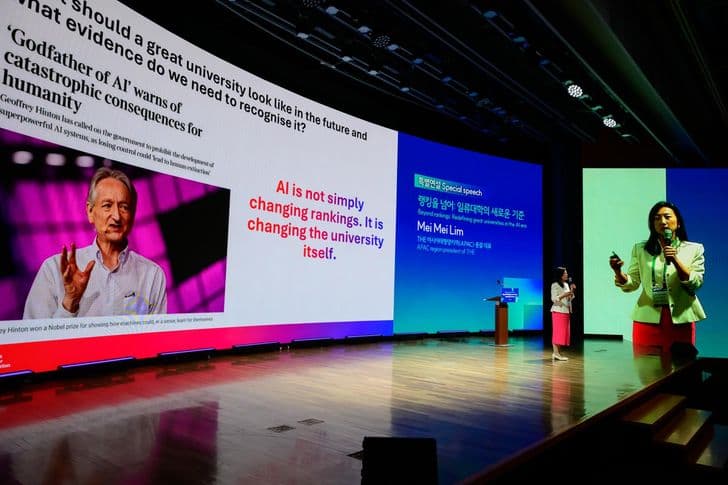
University leaders, policymakers and global higher education experts gathered in Seoul on Tuesday for a conference built around a pointed question for the AI era, what a great university should look like now and what evidence institutions need to recognize it, with speakers converging on the idea that human strengths, not technical proficiency alone, will define the answer.
The event, held at the Korea Chamber of Commerce and Industry under the theme Beyond AI, Building Human-Centered Leadership for Next Era, drew education officials alongside representatives from major global ranking organizations, a pairing that put policy and metrics in the same room to debate what universities are actually supposed to produce.
The Government's Pitch
Education Minister Choi Kyo-jin told the conference that human capabilities such as asking questions, thinking independently, making sound judgments and working with others will become increasingly important as AI advances, framing the technology as raising the value of skills it cannot replicate rather than making them obsolete. A ministry spokesperson, Jeong Byoung-ik, said the goal is to help students retain their humanity, take the initiative in using AI and grow into people capable of leading a changing future. Rep. Kim Hee-jung of the People Power Party added that education should remain centered on people rather than technology, a line meant to guard against letting AI adoption become an end in itself.
What Academics Said Leadership Requires
Choi Jae-boong of Sungkyunkwan University argued that developing leadership starts with accepting the scale of change already underway, telling attendees that to develop leadership, we first have to embrace what is changing. Shitij Kapur of King's College London pushed the point further, arguing that the purpose of AI is to enhance our humanity, not just increase our economic productivity, a framing that positions AI as a tool for human development rather than a replacement for it.
A Challenge to How Universities Are Ranked
Representatives from two major ranking organizations used the platform to question their own industry's tools. Leigh Kamolins of QS said ranking metrics need to evolve to reflect the changing nature of employment, an acknowledgment that existing measures may no longer capture what actually prepares graduates for an AI-altered job market. Mei Mei Lim of Times Higher Education put the challenge to universities directly, saying institutions need to ask what they can do with AI that others cannot, treating AI competency as a new axis of differentiation rather than a uniform baseline every school will eventually clear.
Where the Conversation Is Headed
The recommendations that emerged pointed toward practical shifts: more problem-solving and experiential learning in place of traditional lectures, stronger cross-disciplinary collaboration, and curricula that build AI literacy alongside the distinctly human skills speakers said AI cannot replace. The Korea Times is set to publish its own University Rankings 2027 on September 17, evaluating 60 universities on internationalization and international student support, a release that will test in short order whether Korean institutions are moving in the direction conference speakers described.