
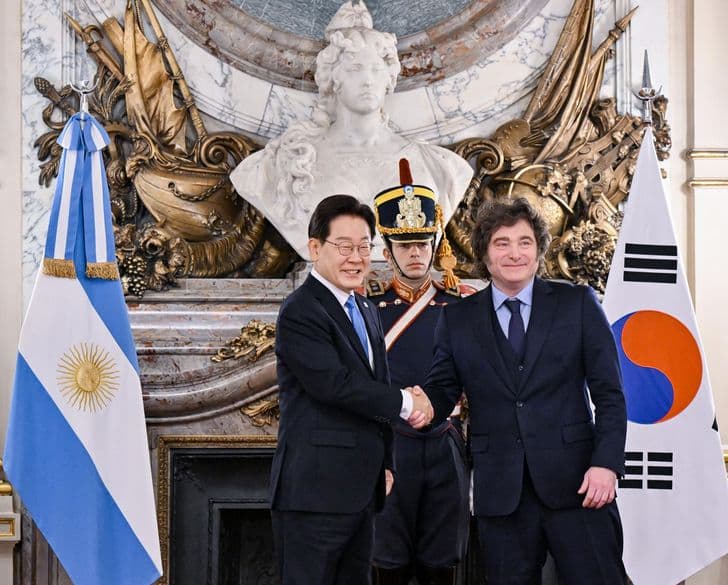
South Korea and Argentina agreed to deepen their cooperation on critical minerals at a summit in Buenos Aires, with lithium at the center of a set of accords meant to tie Korean industry to one of the world's richest sources of the metals that power electric vehicles.
President Lee Jae-myung met his Argentine counterpart, Javier Milei, at the Casa Rosada on July 31, the final stop on a three-nation swing through South America. The meeting turned a tour heavy on symbolism into a handful of concrete commitments.
Lithium across the chain
The centerpiece was a memorandum of understanding on critical minerals, focused on lithium and reaching across the entire value chain, from exploration and mining to the stages beyond. For Korea, whose battery makers depend on a steady flow of the metal, securing access at the source is a strategic priority rather than a commercial nicety.
The two sides paired that with a double taxation avoidance agreement, a less glamorous but practical step designed to ease the tax burden on Korean firms operating in Argentina. Deals of that kind are what turn a mining memorandum into projects companies are willing to fund.
Oil starts to flow
Energy ran alongside minerals. Argentina is set to begin exporting crude oil to South Korea next year, following a pilot shipment earlier in 2026, and the two governments signaled that cooperation could later widen to natural gas and nuclear energy.
National Security Adviser Wi Sung-lac framed the arrangement in terms of resilience, saying it would diversify South Korea's crude oil import sources and help mitigate geopolitical uncertainties. For a country that imports nearly all of its energy, a new supplier in the Southern Hemisphere is a hedge as much as a purchase.
Reviving dormant channels
Some of the work was about restarting machinery that had gone quiet. The two countries agreed to reactivate a joint economic committee and a separate committee on energy and resource cooperation, forums that give the new agreements a place to be managed rather than left to drift.
They also pointed toward the bigger prize, a resumption of trade negotiations with Mercosur, the South American bloc whose members include Brazil, Argentina, Paraguay, Uruguay and Bolivia. Argentina, as a leading member, is a useful partner for a country trying to pry that market open.
The logic of the tour
The Buenos Aires stop closed a trip that also took Lee to Brazil, where he met President Luiz Inacio Lula da Silva, and to Chile. Across all three, the theme was the same, matching Korean manufacturing and technology with the region's minerals, energy and farmland.
No headline dollar figures accompanied the Argentina agreements, and much of what was signed points to future rather than immediate gains. Still, the direction is unmistakable, a Korea working to lock in the raw materials of the energy transition, and choosing South America as a place to do it.