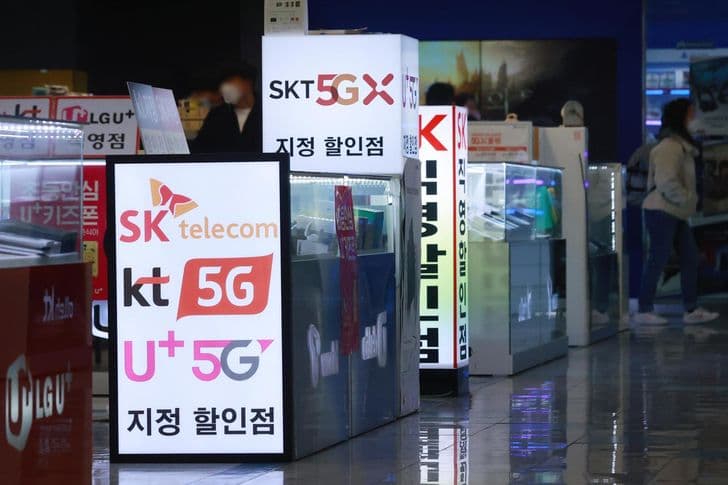
Korea's Big Three Carriers Post Combined $1 Billion Q3 Profit as Weak Year-Ago Base Flatters the Numbers
SK Telecom, KT and LG Uplus reported a combined 1.37 trillion won in third-quarter operating profit, up 83.56 percent from a year earlier, but most of the jump reflects how battered last year's results were rather than a genuine turnaround.
South Korea's three major mobile carriers closed out the third quarter with a combined operating profit of 1.37 trillion won, equivalent to roughly 1.04 billion dollars, a headline figure that looks like a boom year but is mostly the product of an unusually weak comparison point twelve months earlier.
The combined total marked an 83.56 percent increase from the same period last year and came in 10.47 percent above where the industry stood before last year's disruptions, according to the companies' latest filings.
SK Telecom's rebound does the heavy lifting
SK Telecom accounted for much of the swing, posting operating profit of 523.9 billion won, up 981.5 percent from a year earlier. The scale of that jump says less about a breakout quarter than about how deep last year's hole was, when the carrier absorbed heavy one-off costs tied to a damaging data breach and a companywide voluntary retirement program.
With those costs now a year in the rearview mirror, the carrier's affiliate SK Broadband added its own momentum, with executives pointing to fuller data center capacity and a growing roster of enterprise clients as steadier, less one-off sources of profit.
KT grows profit even as sales slip
KT reported operating profit of 549.6 billion won, the largest of the three in absolute terms though the smallest percentage gain at 2.13 percent. The company's overall revenue actually fell 2.24 percent, a divergence the firm attributed to sluggish handset sales that offset otherwise steady growth in its core service business.
LG Uplus leans on cost discipline
LG Uplus posted operating profit of 300.1 billion won, up 85.64 percent year on year. Rather than a single standout driver, the carrier pointed to a mix of efficiency gains from newly deployed AI tools and tighter control of operating expenses across its network and customer service functions.
A sector still waiting on its next growth engine
Taken together, the results describe an industry recovering from a rough patch rather than one finding fresh sources of growth. Service revenue across the sector grew only modestly, and KT's handset slump is a reminder that device sales remain a soft spot even as the carriers lean harder on 5G plans, enterprise data services and AI-linked efficiency to protect margins heading into next year.